

"You should blur their faces next time," some people tell me after I photograph a protest. Here's why I don't, and won't.
Why it's a waste of time and energy — counterproductive, even — to tell protest photographers they should be blurring the faces of the people in their photos

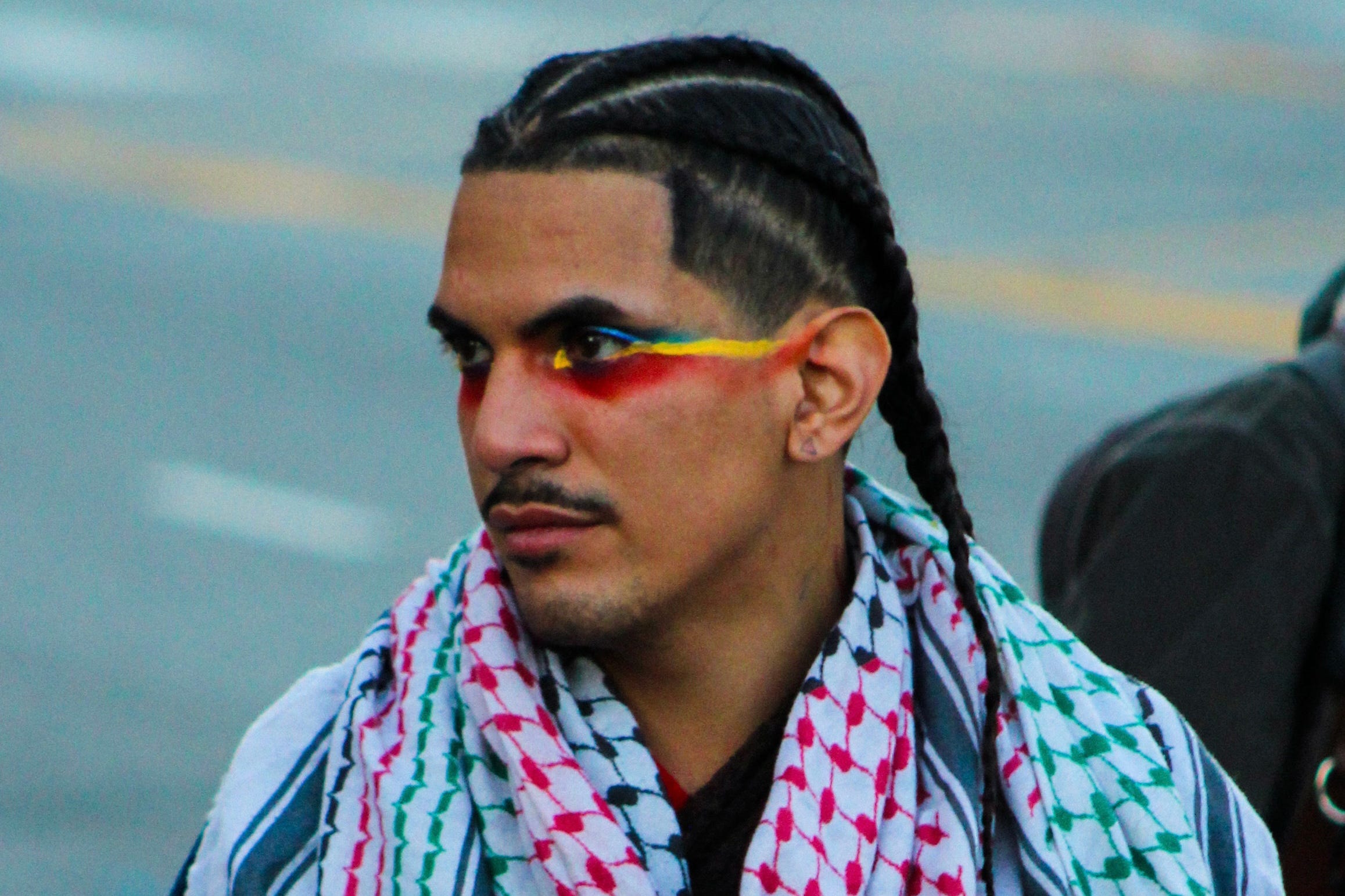
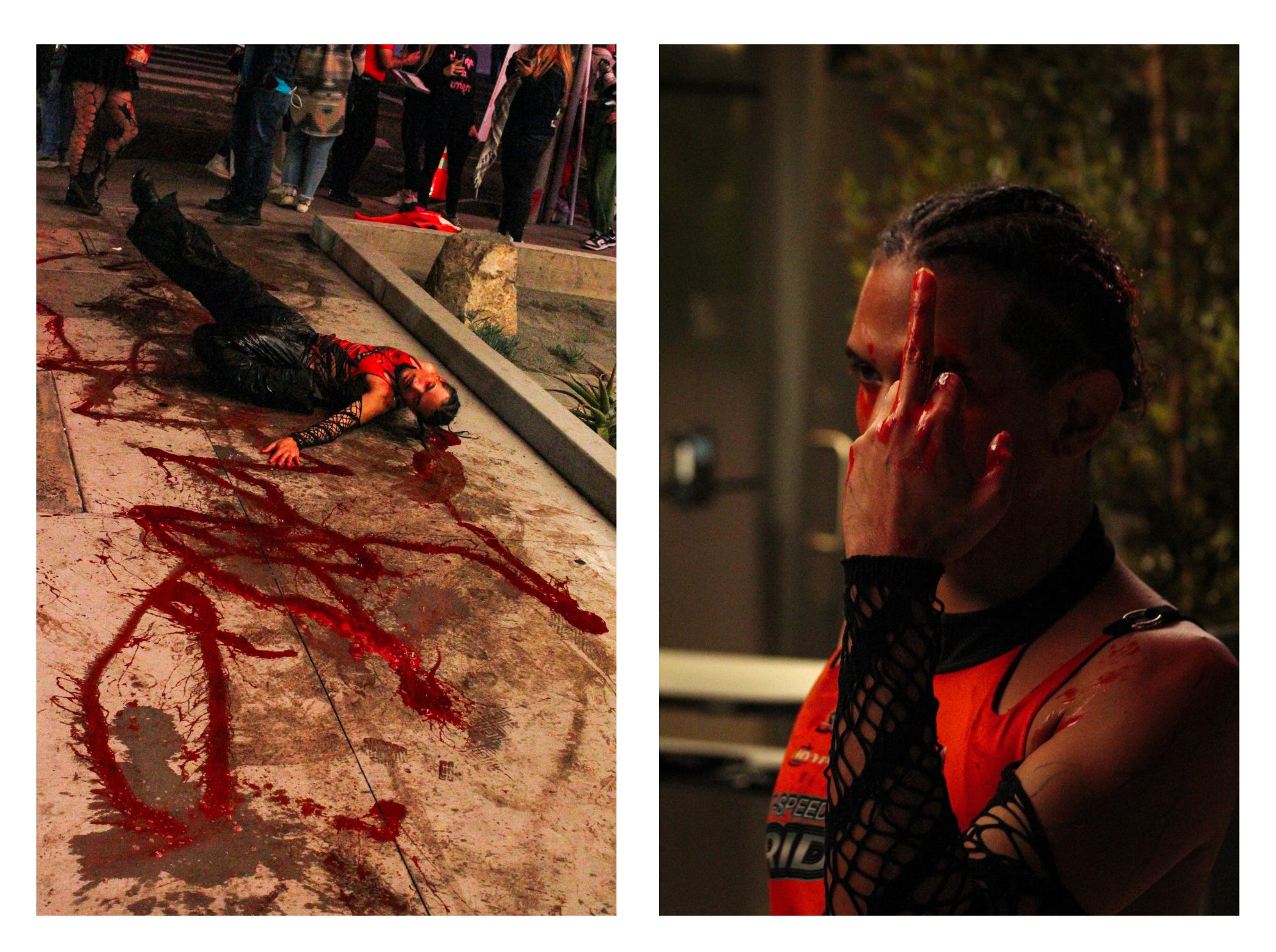
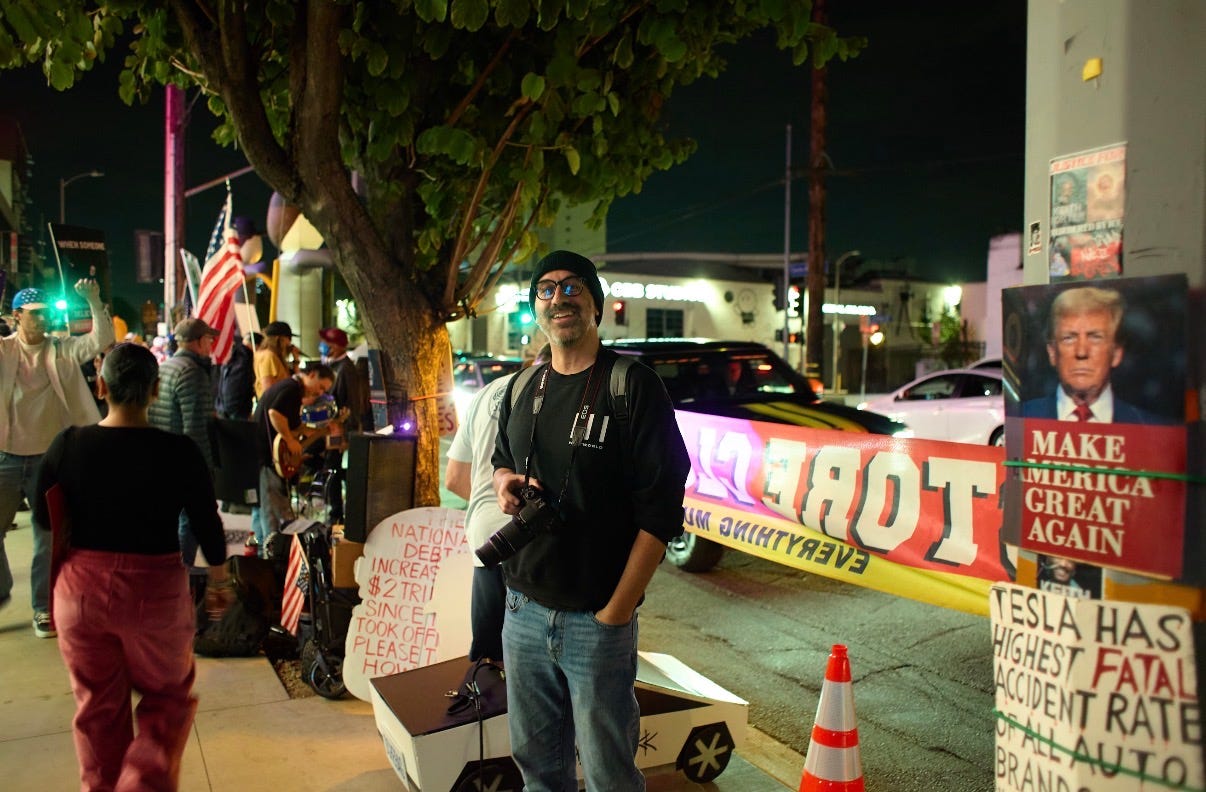
Last night, outside the Tesla Diner in Hollywood, I met someone named Zodiak. They were voguing on a sidewalk covered in fake blood, flashes going off all around them as they dipped, twirled, kicked, and strutted to songs like Chrissa Sparkles’ anthemic “fuck ice.”
(“Play something cunty,” I’d overheard Zodiak ask the bemused, well-meaning, presumably-straight protester with the speaker. “Catchy?” he’d asked hopefully, and Zodiak had gently corrected, “Cunty.”)
After their performance, we exchanged Instagram usernames. “I think I took a photo of you on Saturday, too,” I said, showing them the photo at the top of this piece.
Zodiak said they are happy to take the attention, to be visible and loud for protesters who don’t feel as comfortable being the center of attention. “That’s great,” I think I said lamely, unable to put what I was feeling into words, thinking about the person I’d witnessed make their body into a symbol the other night by stepping onto the driveway at the Metro Detention Center.
Lots of commenters online would’ve had me blur out Zodiak’s face, supposedly for their own good.
I find the very suggestion offensive.
Last night’s Tesla Diner protest was the third event I photographed yesterday.
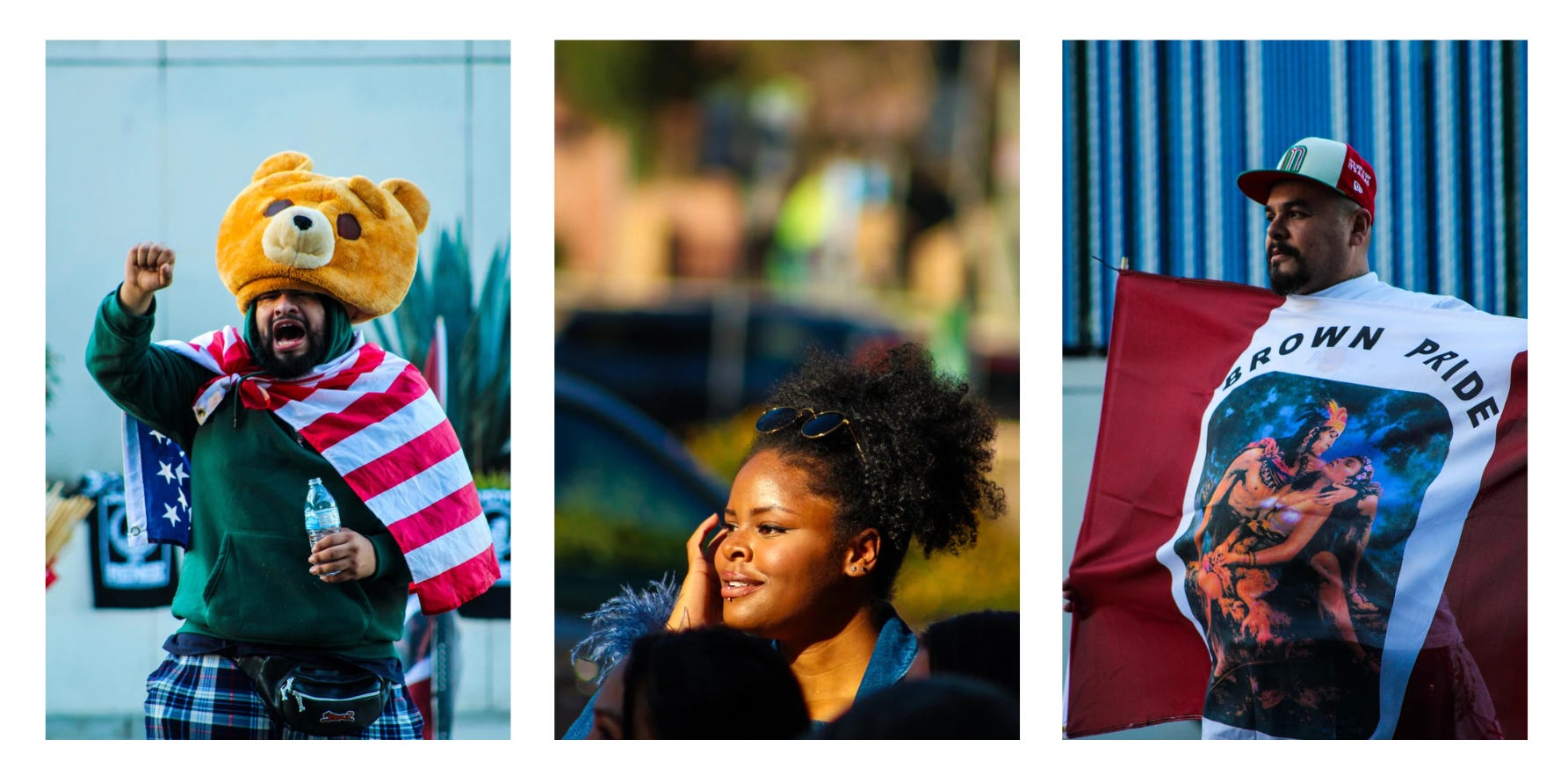
Right around when Zodiak told me they were willing to be visible so that other people don’t have to be, my photos of a protest that evening at the Federal Building in DTLA were picking up steam on Reddit. Numerous organizations had come together in recognition of the recent surge in ICE kidnappings across Los Angeles, drawing attention to the fact that ICE hasn’t gone anywhere and that we’re still not backing down.
I’d shared photos like these:
Here are some of the comments on those photos:
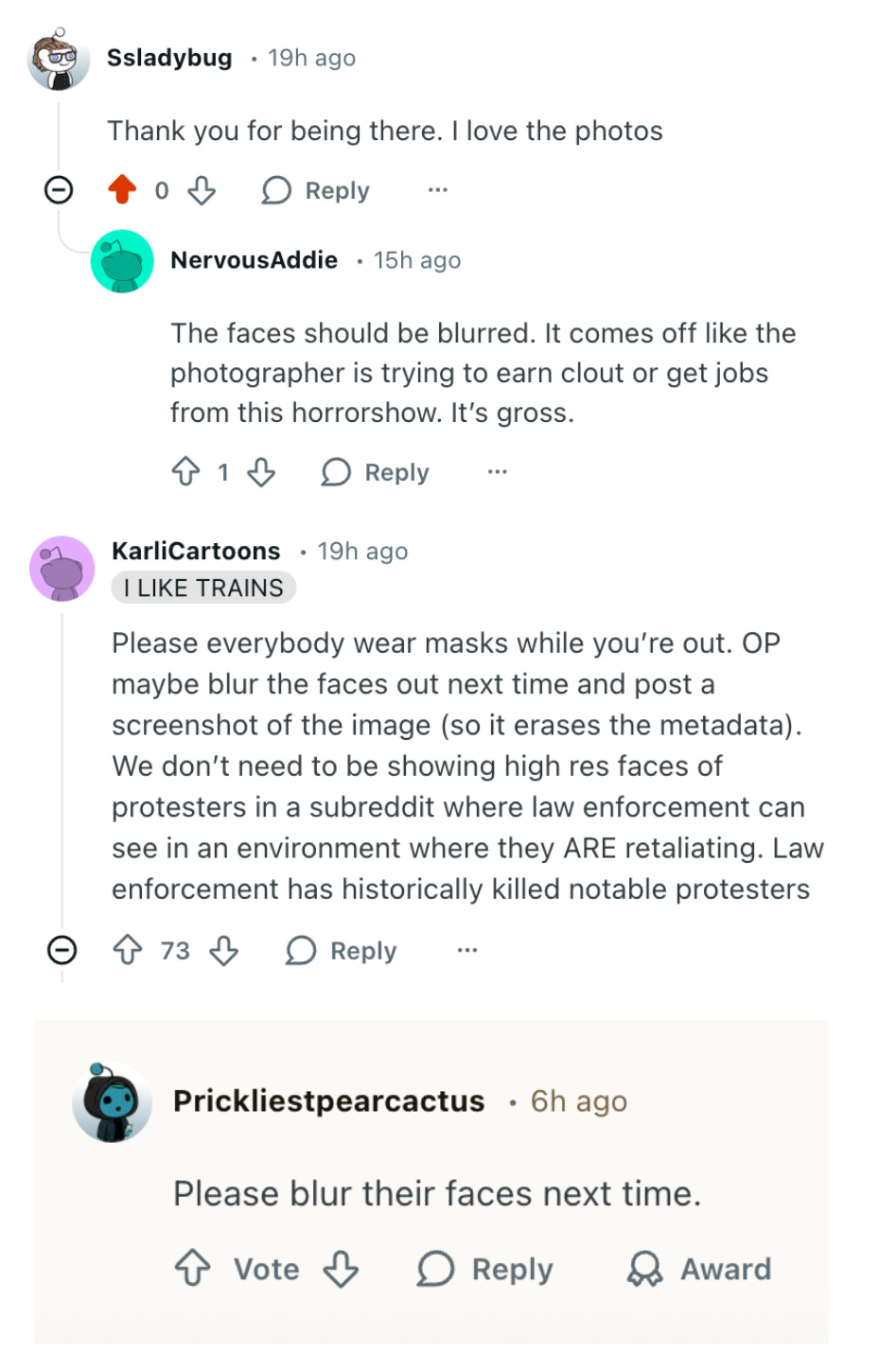
This is a common response to my photos on Reddit. In fact, on a recent /r/AskPhotography thread about how to photograph an anti-ICE protest, numerous people offered “blur the faces” as one of their top pieces of advice.
One even went a step further, telling this guy — who said he’d be going “to document what’s happening” — that he should use AI to protect protesters from the government’s facial recognition systems.
You can also replace faces with AI-generated ones, which keeps us safe and wastes govt time. [source]
I said, in part:
Sorry, but that's not "photography" at that point. It's disinformation. All that does is muddy the historical record.
They replied:
OK, buddy, you go ahead and see if you can sleep at night after publishing photos of protesters and then hear how ICE tracked them down and tortured and deported them.
It went on like that. Someone said, “I think you are underestimating the potential harm to the people you're photographing here.”
I do not think I am. I am well-aware of that harm, and it quite literally keeps me up at night… and I think to argue instead for their erasure is worse.
“Your arrogant ignorance and stubbornness is kind of appalling,” someone said. “… you don't show anyone if you don't have to. Let the government have their surveillance state. Don't be part of it. Jesus fucking Christ, this isn't hard.”
I think this line of critique is not just a waste of time and energy, but reveals a dangerous lack of understanding of the situation we find ourselves in.
I believe these people mean well.
I believe these people think they’re looking out for one another. I believe they’ve seen other people giving each other this suggestion online, and they thought, ‘That sounds reasonable!’ and so they’ve passed it on. The surveillance state is scary, and facial recognition is scary, and no one wants to be responsible for someone else getting snatched.
But… I am genuinely unsure if these people have been to a protest in the last ten years.
Every single person at one of these events knows they are being photographed, and being seen is specifically what gives the act of protesting its power.
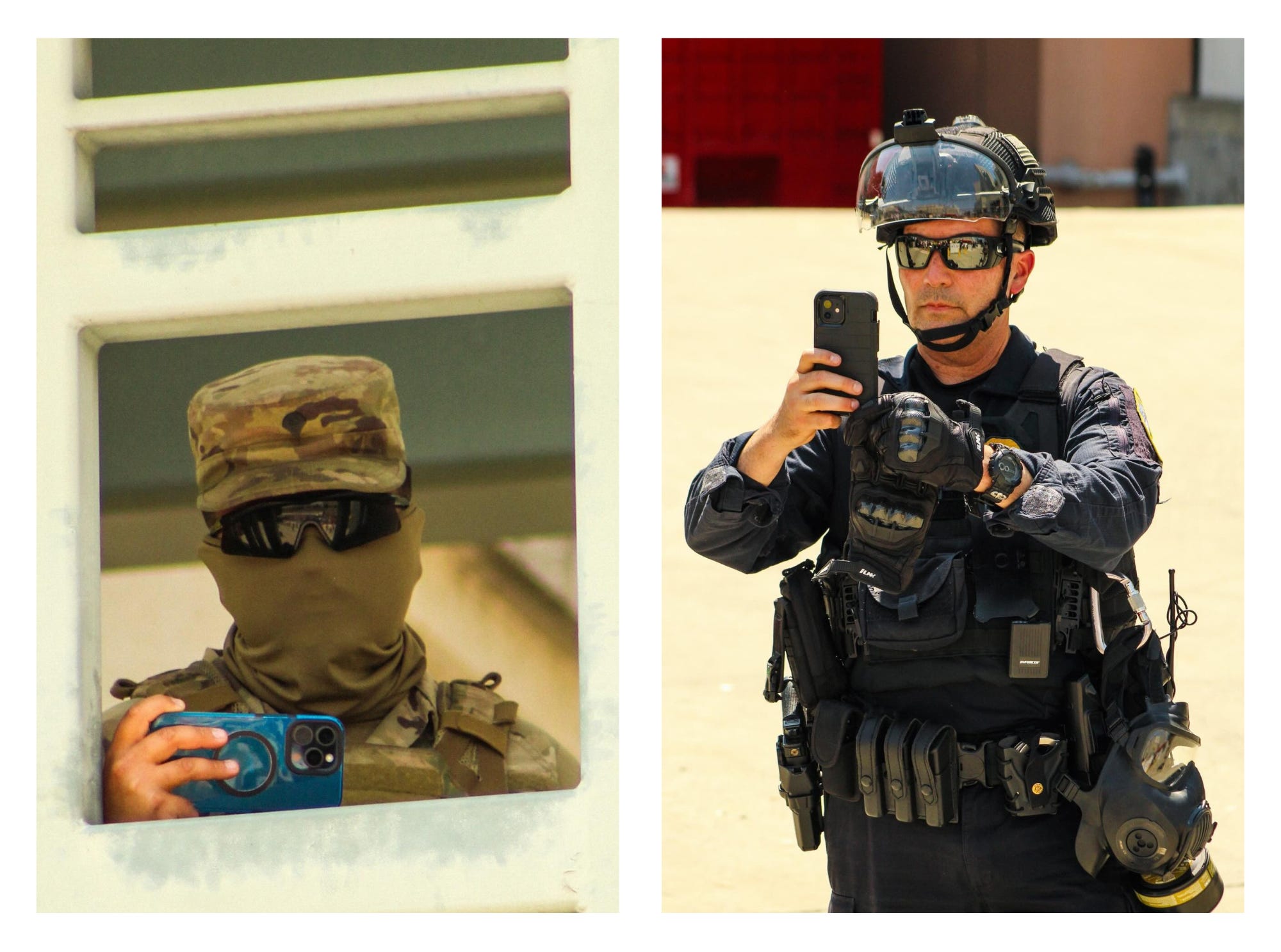
It is hard to overstate how many cameras are present at a protest, especially one in Los Angeles. Let’s take that Federal Building event from yesterday, for example. In just those 20 images I shared on Reddit alone, there are cameras visible here:
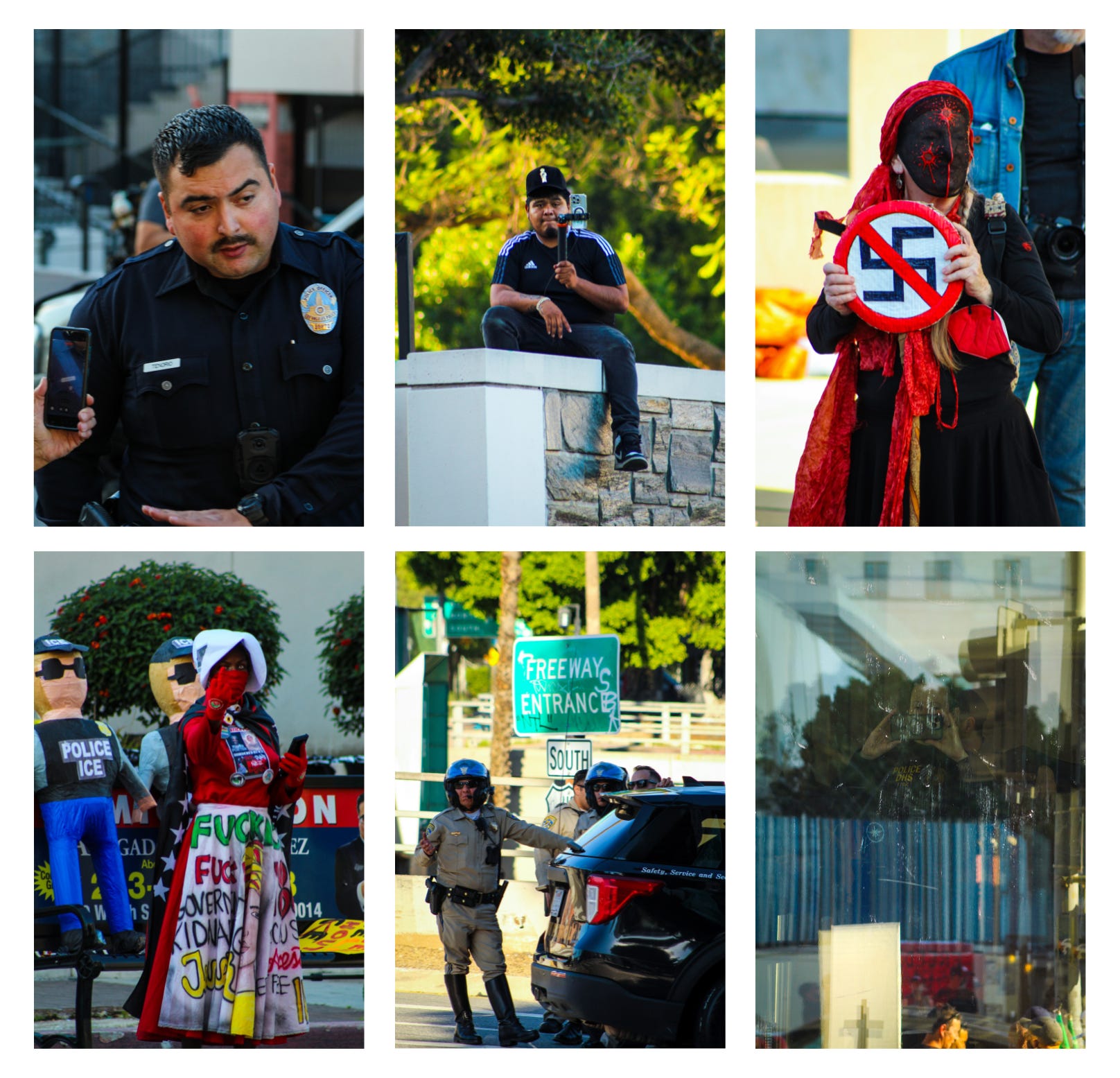
People everywhere — both protesters and bystanders — are filming these things on cell phones. There are often news cameras, with reporters broadcasting live. There are police helicopters overhead. The cops have body cameras, and they use their cell phones too. There are many, many obvious security cameras. Every Waymo that drives past is recording, as is every Tesla, and any other car with a dashcam. There are often dozens of other photographers, many of whom are professional photojournalists, whose images wind up on press wires like Getty or Zuma or Reuters, able (and likely) to be reproduced all over the world. Those photos will not have faces blurred.
It’s an insult to a protester’s intelligence to pretend like they have no idea they’ll be photographed.
So here’s the ethical standard I’ve set for myself before I post something online:
Could this photo tell the government something they don’t already know?
And I would argue that even the question itself is laughable.
Because they already know everything.
Before we can talk about whether my photos endanger people, we need to understand the base reality of the world we live in.
Someone told me on Reddit, “It is … your own personal responsibility to help keep our community safe.” The phrasing “keep our community safe” assumes that we are safe, and that my actions will make us unsafe.
We are not safe.
404media broke the news that ICE has new tools called “Tangles” and “Webloc.” They can quite literally draw a circle on a map and get identifiable information about every phone within the boundaries, including locations where it spends significant amounts of time, allowing them to deduce homes and workplaces. They see other phones it’s been near, and when, and for how long.
Great, so you left your phone at home, having seen the “never bring your phone to a protest” advice that goes around online.
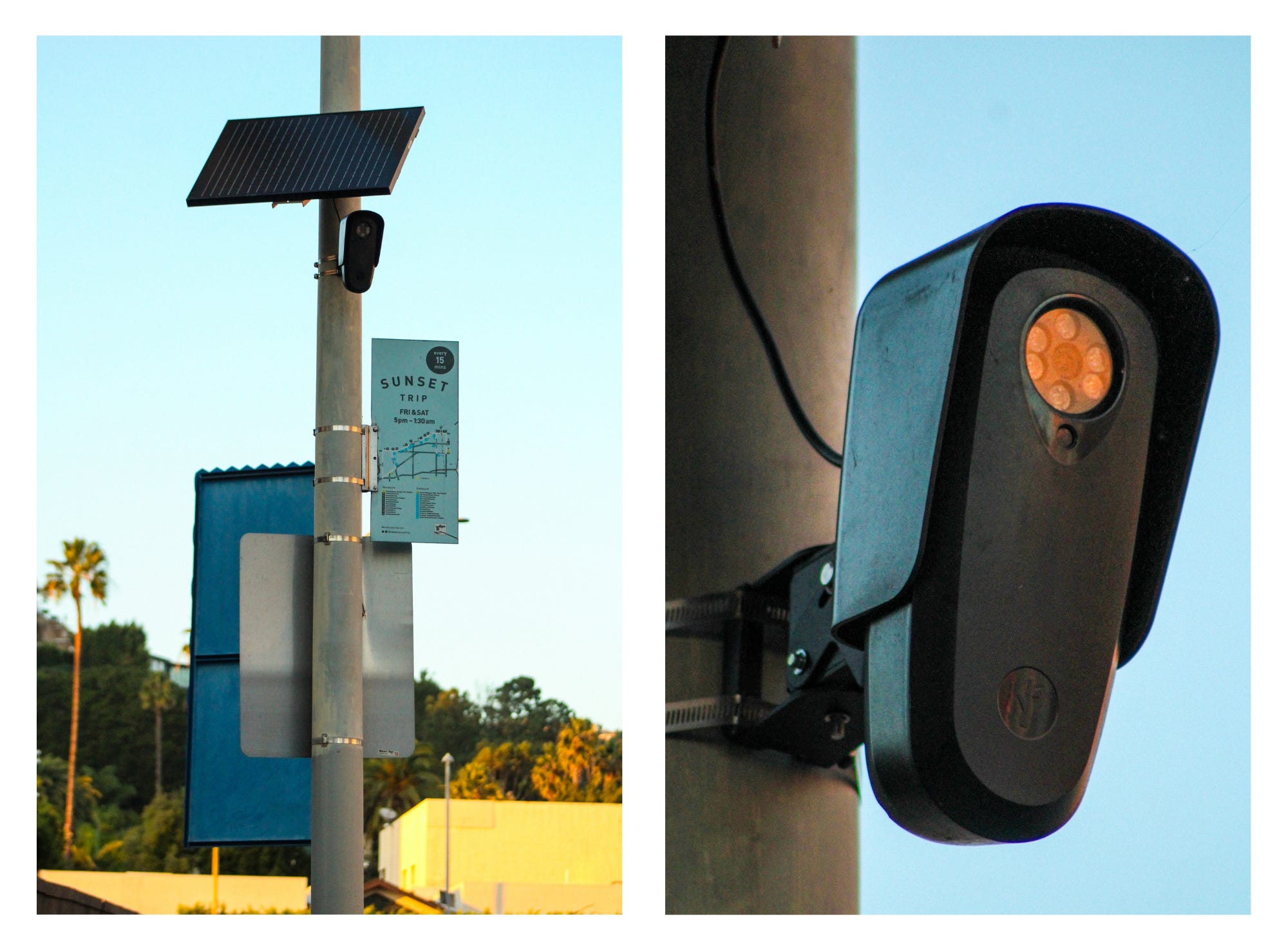
If you drove there, though, ICE can use the Flock camera system to retrace your entire route. Sure, Flock says ICE doesn’t have a contract, but they also accidentally made any one contract holder able to leak all search data — oops! — so we know thanks to 404media that searches are being done for immigration and protest-related reasons. It’s ostensibly an ALPR — an “Automated License Plate Reader” — but these AI-powered cameras log cars billions of times a month, and they don’t just read license plates, either; they are motion-activated for human movement, too. As 404media has noted, they even left many of them streaming openly on the Internet. …Oops!
If you took public transportation to the protest, did you tap your phone to pay? They know which bus route you took. Oh right, you left it at home; did you use cash? There are security cameras on the bus, and at the bus stop, both where you got on and where you got off.
If you walked, there’s a good chance you walked past a Ring camera, if not many of them. Those tie into the Flock system, too — here’s the source — meaning the AI-powered surveillance state has proof of when you go out for a walk around your neighborhood, let alone to intentionally stand on the side of a busy street outside a Federal Building at rush hour.
If you didn’t pass any Ring cameras, but happened to walk past a business with closed-circuit TV cameras… well, if ICE wants to know if you were there, your local police department might just help them seize the security footage from that business and then delete the business’s copy.
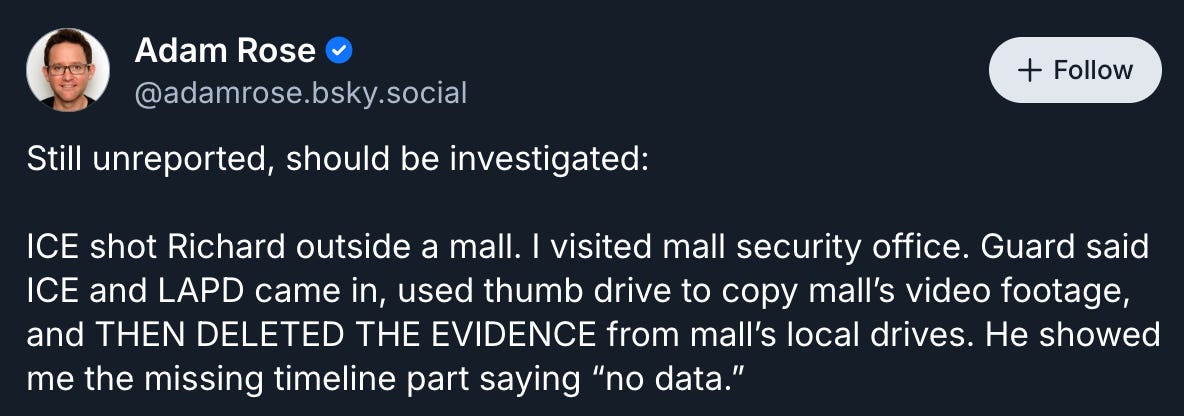
In other words, if we’re really heading to a point where just attending a protest will be criminalized… they’ll already know who’s there.
That is the base reality we live in. I understand that it’s scary and unsettling and weird, and none of us wish it was the case, but it is true.
“The most basic rule of covering protests is obscuring faces. Seriously,” someone commented.
I do not agree. (They’re the one who called me “arrogantly ignorant” above when I replied to this by asking “…Says who?”)
Let’s leave aside the fact that I have “the right” to photograph people in public. Here’s why I do it, and how I’ve reached the conclusions I have. You’re free to disagree, but this is my thinking.
None of the dozens of professional photojournalists who sell their images on the wires will be blurring faces, so what other definition of “covering a protest” could we possibly be working under here? Are we arguing that no one should be publicizing the fact that protests are happening? Is an information blackout really what we want right now?
The battle to keep any information about protesters from hitting the system has already been lost so completely that spending time on it is absurd. Imagine someone is spraying a firehose through your mesh window screen. There’s no sense in trying to keep the rug inside from getting wet by putting a tiny piece of scotch tape on the bottom corner of the screen, and then getting angry when people don’t see the point.
You work together to figure out how to turn off the hose before it floods your house.
On the other hand, I do think it is commonly-understood that the most basic rule of attending a protest is to assess your own comfort with being seen doing so.
The point of a protest like this — a crowd of people gathered in a physical space to support a cause — is being seen. Objectively. Inextricably.
Furthermore, for me, protesting like this specifically draws its power from the basic assumption that the people who are attending know it’s dangerous, and they’ve decided to show up anyway. Like Zodiak, who is willing to take the attention from people who would prefer to be more anonymous, any given protester is quite literally putting their body on the line to be seen showing up for something important, so that other people can do other kinds of work.
Six years after the COVID pandemic hit, I promise you that if people don’t want to be seen, they are aware of the concept of face coverings. I promise you that people who attend these protests know full well that they can put on a hat, or a full-face mask, or dress in a big blow-up inflatable frog, or slather themselves in crazy makeup, or hide behind sunglasses, or goggles, or a keffiyeh, balaclava, bandana, netting, or all of the above…. or none of it.
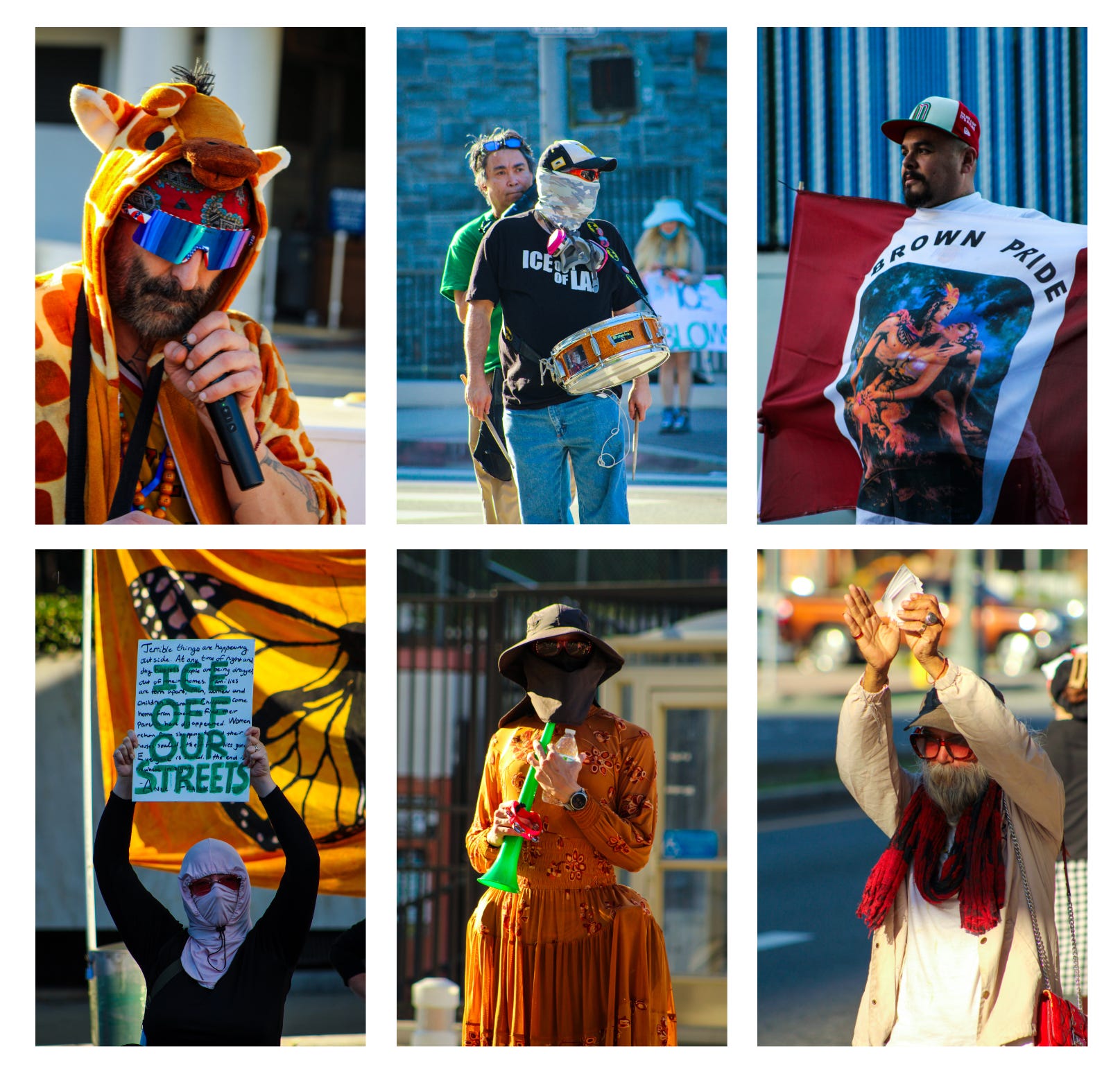
I don’t think it’s “arrogant” for me to represent people in my photographs as they’ve shown up in the space.
I think the arrogant move would be to blur their faces, or put stickers over them, or even worse, replace them with AI faces. To me, that says, I know better than you. It says, I’d rather — both literally and metaphorically — erase you from the event in an attempt to ease my own hypothetical guilt.
That’s arrogance, and for me, it fails as both documentary and art.
By photographing people this way, I am operating from the base assumption that they are human beings with agency.
Someone told me that I have the opportunity to make a series of choices between taking a photo and posting it online, derisively suggesting that I am consciously choosing not to blur faces. That’s true!
But I am operating from the base assumption that the people in my photos are also people with internal lives, who have also made a series of choices. Between hearing about a protest and attending it, I feel I am granting people the dignity of assuming they have made a series of intentional choices about their own level of comfort and safety. Specifically, I am assuming people are able to make their own choices about how they want to look, specifically based on how comfortable they are with the idea of being seen.
This conversation isn’t just a waste of everyone’s time; it’s a dangerous misunderstanding of the moment.
By putting so much focus on how dangerous it is for there to be photographic proof that someone attended a protest, you suppress turnout. People hear that they should be afraid of the idea that they’ll be in an Instagram photo, and so they stay home, thinking ICE is going to break down their door if anyone can prove they went outside near a sign that says “Fuck Trump.”
You should not be afraid of the protest photographer who’s “arrogantly” refusing to even consider replacing you with AI.
You should be afraid of — and working to dismantle — the systems that would ever make someone think that’s an acceptable alternative in the first place.
This week, Wired published a headline that read, Minnesota Is Just the Beginning. California and New York Are ‘Next’
I’ve been frightened by this framing, which has spread across social media.
“The Second Civil War is beginning in Minnesota!” people are saying. “Minnesota is the testing ground for what comes next!”
Los Angeles has been fighting this, hard, since June 2025. Trump seized the California National Guard! They sent the actual, full-on Marines against us! They used what they learned here and went on to Portland, and Chicago, and DC, and New Orleans, and when I pointed out on Threads that Minnesota isn’t the start of anything, people said that LA faced nothing like what Minnesota’s facing, because ICE left here, but in MN they’re escalating. People had no memory of the Marines having been deployed here, and even the ones who were willing to take my post charitably asked for advice about “how we got them to leave.”
They haven’t left. They’ve ramped up now that the attention is elsewhere, kidnapping 500+ people in Southern California in December alone. They snatched people all across Los Angeles this week, violently, their masks up, their weapons swinging from their belts, the implicit threat of violence everywhere they went.
And on Friday, a bunch of people were brave enough to show up at the Federal Building, gathering in a physical space, using the fact of their presence to amplify the message. That’s what I’m trying to do with my photography, too — to honor that risk. Those photos — faces, facemasks, and all — have been seen ~1.5M times and counting on Reddit, reminding all of those people that Los Angeles is facing this, too, and has been, and will continue to be. We’ll continue to show up.
And that’s just my photos. There were, again, many other photographers there, and those pictures are out there too, being widely seen, changing minds, serving as proof and promise of both the individual and the collective, as documentation and demonstration that we’re not just going to let this happen unopposed.
And I’d encourage you to figure out how to join in.
You are documenting history and it is unethical to mess with images for this purpose. Keep on keeping on. People who protest do so to be seen.